
Your laptop works just as well in Kotor as it does in Berlin, yet the tax office in each country sees your stay very differently. The rule behind Montenegro tax residency for remote workers is simple: you become a tax resident if you spend more than 183 days in the country during a calendar year, or if Montenegro becomes the centre of your personal and business interests.
Either condition on its own is enough, and once you are resident, Montenegro can tax your worldwide income, including the salary a foreign employer pays into a foreign account. The surprises usually come from everyday choices, like a long lease or one extra summer month on the coast.
If you are planning a longer stay, we can help you choose the permit that fits how you actually work.

Key Takeaways
- Montenegro treats you as a tax resident after more than 183 days of presence in one calendar year.
- A family home, main residence or local business in Montenegro can make you resident with fewer days.
- Arrival and departure days count as full days, and separate trips add up across the year.
- A residence permit or digital nomad card does not decide your tax status on its own.
- Tax residents report foreign income in an annual return due by 30 April.
- Double tax treaties and foreign tax credits help you avoid paying twice on the same income.
When Does a Remote Worker Become a Tax Resident in Montenegro?
Montenegro tax residency for remote workers rests on two tests, and meeting either one is enough: you stay more than 183 days in a calendar year, or Montenegro is where your domicile or centre of business and personal interests lies. The second test can apply after a much shorter stay.
When clients bring us a mixed situation, such as a family in Budva and an employer in London, our personal tax planning advice starts by checking both tests side by side.
Both tests sit in Article 3 of the Law on Personal Income Tax, available among the laws adopted by the Parliament of Montenegro. The same article keeps residency for people posted abroad by a Montenegrin employer or an international organisation. Where a double tax treaty applies, it can override the domestic result.
The quick check below follows the same order the Tax Administration uses:
A simplified guide based on Article 3 of the Law on Personal Income Tax. Mixed situations need an individual assessment.
The 183-day test
The law says more than 183 days, so 183 days on the dot keeps you below the line and day 184 takes you over it. The count runs per tax year, which in Montenegro equals the calendar year from 1 January to 31 December. Some summaries say “at least 183 days”, so leave yourself a margin of a week or two.
The centre of vital interests test
The second test looks at where your life is anchored, with no day count at all. The Tax Administration (Poreska uprava) weighs several personal and economic ties.
In practice, it asks:
- where your spouse, partner or children live
- where your main permanent home or primary apartment is located
- where your employment, business or company, for example a local d.o.o., is based
Owning an apartment counts as one supporting fact among several; on its own, it rarely decides the outcome. Several ties together weigh far more. An owner with a family home in Budva who spends 150 days there each year can be treated as resident, with all foreign income included.
How Montenegro Counts Your Days
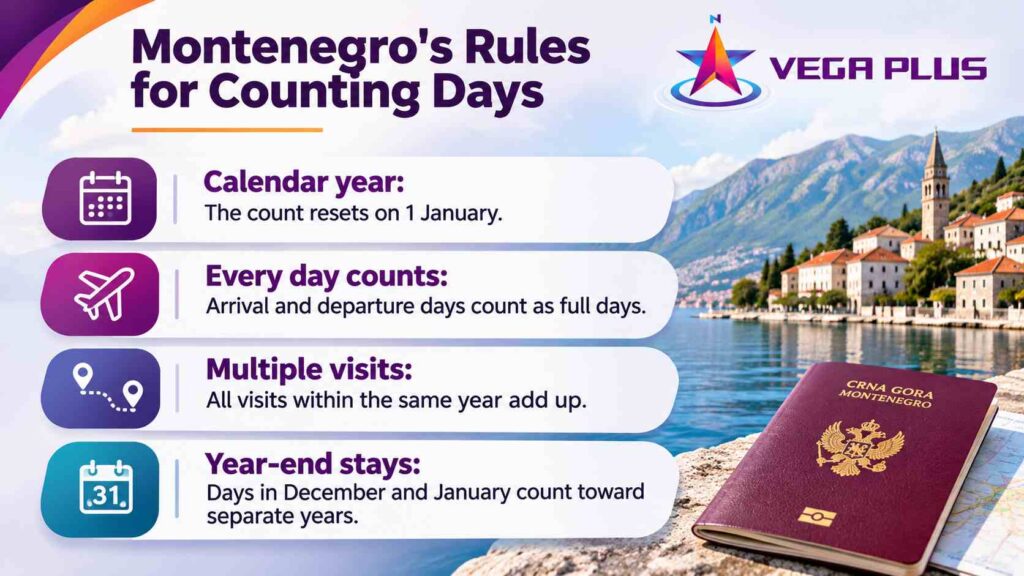
Day counting in Montenegro is a plain presence count. Every day you are physically in the country counts, whatever permit you used to enter. Four rules catch remote workers most often:
- Calendar year only: the count resets every 1 January, with no rolling twelve month window.
- Partial days count in full: landing at 23:00 or leaving on a 6:00 flight still adds a day.
- Trips add up: stays do not need to be consecutive, so spring and autumn visits form one total.
- New Year splits the stay: a visit from November to February counts toward two separate years.
A copywriter who spends March to May in Herceg Novi (92 days), returns for July and August (62 days) and comes back for most of October (25 days) ends the year on 179 days. Five days at Christmas would make her resident. A simple log with flight confirmations and border stamps is worth keeping.
The example and the calculator below show how quickly the days add up:
Day 184 makes you a tax resident. Five days at Christmas would push this year over the line.
Enter each stay (arrival and departure dates). Arrival and departure days count as full days, and overlapping dates are counted once.
An estimate only. It does not check the centre of interests test, which can make you resident with fewer days.
The figure has a long pedigree. 183 is just over half a year, and the same number appears in the OECD Model Tax Convention, the template behind most tax treaties Montenegro has signed. Leap years change nothing, since the threshold stays at more than 183 days.
Residence Permit and Tax Residency Are Separate Questions

Permits are where Montenegro tax residency for remote workers most often gets confused with immigration status. A residence card is issued under immigration law, while tax residency is decided by the Tax Administration under tax law. Holding a temporary residence permit or a Digital Nomad card does not automatically make you a tax resident, and it does not guarantee non-resident status either. Presence and personal ties decide the tax side.
The digital nomad permit
The permit targets people working online for a foreign company or their own company registered abroad. According to the government’s digital nomad portal, the permit is valid for up to two years and can be extended for up to two more, with the extension filed in person at least 30 days before expiry. After it ends, a new permit can be issued six months later.
What the tax relief covers
Amendments published in the Official Gazette of Montenegro no. 152/22 on 30 December 2022 introduced a tax exemption for digital nomads. Income from an employer or clients not registered in Montenegro is exempt from personal income tax and mandatory social contributions while you hold digital nomad status. Fees from a Montenegrin company are taxed normally, and your home country may still expect tax on the same income.
What Changes Once You Are a Tax Resident
Residency switches Montenegro’s view of your income from local to global. Non-residents pay tax only on Montenegrin source income, such as a local salary, rent from a flat in Tivat or dividends from a Montenegrin company. Residents are taxed on income earned here and abroad, which for most remote workers means the foreign salary or freelance fees they arrived with.
Good records make the switch painless. Our accounting services cover bookkeeping, reporting and tax return preparation. Clients with their own company also get payroll calculation and compliance monitoring.
Rates residents pay
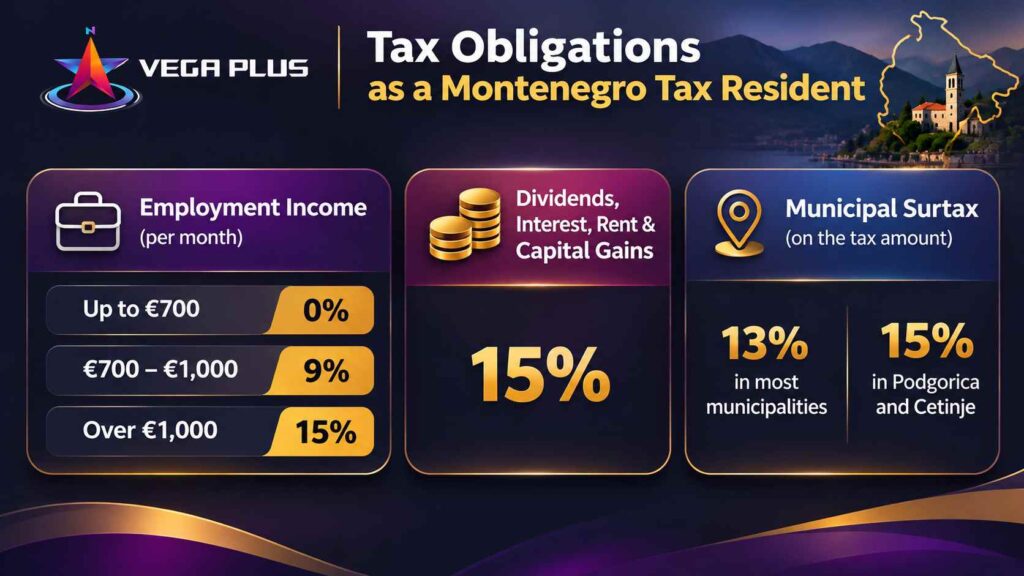
Montenegro’s personal income tax stays modest by European standards. The rates below apply in 2026. They are the figures most remote workers will meet:
- Employment income (monthly): 0% up to €700, 9% between €700 and €1,000, and 15% above €1,000
- Dividends, interest, rent and capital gains: generally 15%
- Municipal surtax (prirez): 13% of the tax amount in most municipalities, 15% in Podgorica and Cetinje
The surtax is calculated on the tax, so 15% income tax plus a 13% surtax works out to roughly 17% of the income. Montenegro has used the euro since 2002 without joining the eurozone, so euro income needs no conversion. Other currencies use the official rate on the day of receipt.
Illustrative calculation using the 2026 brackets (0% up to €700, 9% from €700 to €1,000, 15% above €1,000) and a 13% municipal surtax. In Podgorica and Cetinje the surtax is 15%. Social contributions and digital nomad exemptions are not included. Source: PwC Worldwide Tax Summaries.
Residents with foreign income file an annual return by 30 April. Tax paid abroad is credited, up to the amount Montenegro would charge. Keep payslips and foreign tax certificates as proof.
Common Remote Work Scenarios at a Glance
Real situations rarely fit one category. The table shows how Montenegro tax residency for remote workers usually plays out in practice. Treat it as a starting point.
| Your situation | Likely tax status | What Montenegro taxes |
| 120 days as a visitor, home and family abroad | Non-resident | Only Montenegrin source income |
| 200 days on a digital nomad permit, foreign employer | Resident by day count | Foreign work income exempt under nomad status; other income under general rules |
| 150 days, family and main home in Budva | Likely resident under the centre of interests test | Worldwide income |
| 190 days on a temporary permit through your own d.o.o. | Resident | Worldwide income, with your d.o.o. salary taxed through payroll |
| Posted abroad by a Montenegrin employer | Resident | Worldwide income |
If the fourth row describes your plans, the company brings its own registration steps. Our business setup service covers legal structure, company registration, tax ID and VAT registration and a registered business address, while the Tax Administration’s guide to founding a company lists the official steps. The company files its own monthly and annual returns, wherever you as the owner are resident.
When Two Countries Claim You as a Resident

Your home country may still call you resident after 183 days here. Where a double tax treaty exists, it settles the question in a fixed order.
The tie-breakers are:
- where you have a permanent home available
- where your centre of vital interests lies
- where you have a habitual abode
- your nationality
- mutual agreement between the two tax authorities
To use a treaty, you usually need a certificate of tax residence from the Tax Administration office in your municipality. Expect to show your passport, residence card, address registration and proof of presence. If you are unsure which country wins the tie-break, contact our team with your day count, housing and income sources.
Records Every Remote Worker Should Keep
Whether you want to stay non-resident or prove residency for a treaty, the burden of proof is on you. These are the documents we ask clients to keep from day one:
- A travel log with every arrival and departure date, especially around New Year
- Flight confirmations, boarding passes and border stamps
- Your lease or property documents and address registration
- Payslips, invoices and contracts showing who pays you and from where
- Foreign tax certificates, to claim a credit for tax already paid abroad
- A certificate of tax residence from the Tax Administration, if you rely on a treaty
Frequently Asked Questions
Final Thoughts
Montenegro tax residency for remote workers fits on a single page: more than 183 days, or a life centred here, and your worldwide income comes into play. Most remote workers who get caught out simply never counted their days. A day log and a quick look at your home country’s treaty answer most questions early.
For the bookkeeping side, our guide to accounting services for digital nomads in Montenegro picks up where the tax rules leave off. We are happy to help you line up your permit, company and tax position. Reach out whenever your plans or travel pattern change.
Sources and legal references
- Parliament of Montenegro – Law on Personal Income Tax (Article 3)
- Government of Montenegro – Digital nomad portal: legal status for nomads
- Official Gazette of Montenegro no. 152/22 – digital nomad tax exemption
- PwC Worldwide Tax Summaries – Montenegro, taxes on personal income
- ePorezi – Company formation guide
This guide is general information, not tax advice for your specific situation. Tax status depends on your full circumstances and on any treaty with your home country, so confirm the details with us or a licensed advisor before you act.