
Picture a small software company in Podgorica closing its books with €80,000 of profit. Its corporate tax bill comes to €7,200, paid in one go by 31 March of the following year, with no monthly instalments along the way. That is corporate tax in Montenegro in a nutshell: a progressive rate of 9%, 12% or 15% depending on profit, settled once a year.
The headline rates are low by European standards, but the fine print still matters. Withholding tax, transfer pricing files and related deadlines carry their own rules and fines. Knowing where they sit before your first tax year closes saves a lot of trouble in March.
Our team at VegaPlus helps companies plan around these numbers before the books close. If you want to know which bracket your company will land in, or how dividends and expenses affect the final figure, our tax advisory service covers corporate and personal tax planning, dividend and profit planning and tax optimisation strategies.
We also offer VAT advisory, capital gains guidance and audit and inspection support. The aim is to balance efficiency, compliance and long-term stability.
Key Takeaways
- Montenegro taxes company profit progressively at 9%, 12% and 15%, with no municipal corporate tax on top.
- The annual return and the full tax payment are both due by 31 March of the following year.
- There are no monthly advance payments, so the entire year’s tax is settled in a single payment.
- Dividends, interest and royalties paid to non-residents usually carry 15% withholding tax, or 30% for tax havens.
- Tax losses can be carried forward for five years, but they cannot be carried back.
- New companies in underdeveloped municipalities may qualify for an eight-year exemption capped at €200,000.
What Are the Corporate Tax Rates in Montenegro?
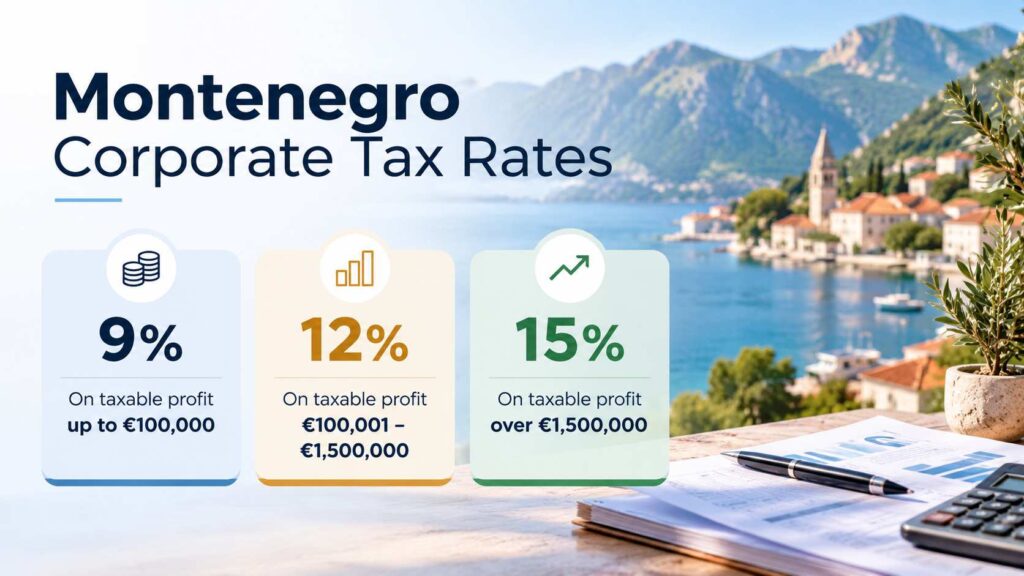
Montenegro uses three profit brackets, and each rate applies only to the slice of profit inside it. Profit up to €100,000 is taxed at 9%, the portion between €100,000 and €1.5 million at 12%, and anything above €1.5 million at 15%. Resident companies pay on worldwide profit, while foreign companies pay only on income earned in Montenegro or through a local branch.
How the Brackets Work in Real Numbers
Because the rates are marginal, crossing a threshold never pushes your whole profit into a higher rate. A business earning €400,000 pays 9% on the first €100,000 and 12% on the remaining €300,000, a total of €45,000 and an effective rate of about 11.25%. The table below shows the calculation at each level.
| Taxable profit | How the tax is calculated | Example |
| Up to €100,000 | 9% of profit | €80,000 profit: €7,200 tax |
| €100,000.01 to €1,500,000 | €9,000 plus 12% on the amount above €100,000 | €400,000 profit: €45,000 tax |
| Above €1,500,000 | €177,000 plus 15% on the amount above €1,500,000 | €2,000,000 profit: €252,000 tax |
Municipalities add no local corporate tax, so the figure from the table is the figure you pay. What matters is taxable profit, meaning accounting profit adjusted for expenses the law does not recognise.
Our accounting team at VegaPlus handles bookkeeping and financial records, payroll, monthly and annual reporting and tax return preparation, the records taxable profit is calculated from.
Filing Deadlines: Why 31 March Matters So Much
For most companies the tax year is the calendar year. By 31 March, a company files its annual corporate tax return (the PD form with the tax balance), submits its financial statements with the statistical annex and pays the full tax for the previous year.
The deadline is set by Article 40 of the Law on Corporate Income Tax, and returns are filed electronically through the Tax Administration’s IRMS portal.
No Advance Payments During the Year

Montenegro does not require companies to prepay corporate tax in monthly instalments, as the ePorezi corporate tax guide also confirms. The practical consequence is one large payment in March, so moving part of each month’s profit into a separate business bank account in Montenegro is a sensible habit. Corporate tax planning and monthly reporting, both part of our services at VegaPlus, make it easier to see that bill coming.
Other Dates for Your Calendar
Corporate tax rarely travels alone. Missing any of the related deadlines can trigger fines even when the main return went in on time.
The ones that matter most for a typical d.o.o. are:
- End of February: annual IOPPO report on withholding tax paid during the previous year.
- 31 March: corporate tax return, tax payment and annual financial statements.
- 31 May: consolidated financial statements, for groups required to prepare them.
- 30 June (until 2027): transfer pricing documentation for large taxpayers.
- 30 days after earning the income: tax return for non-residents with capital gains or rental income in Montenegro.
- 15th of each month: VAT and payroll (IOPPD) returns, where applicable.
What Shapes Your Taxable Profit
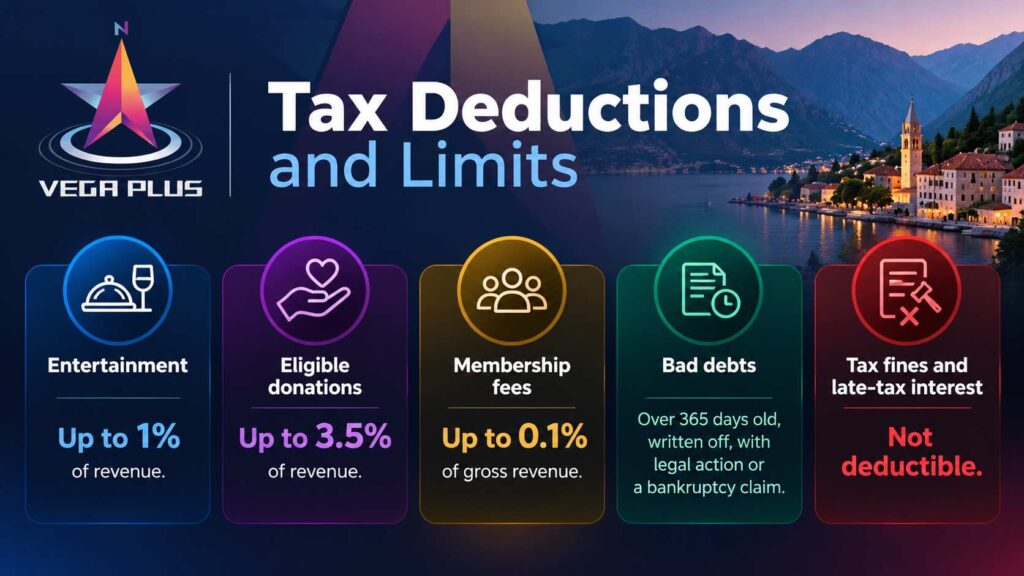
Business expenses are deductible as long as they serve the business and are properly documented. Some categories come with ceilings, and a few are never deductible at all. The main limits look like this:
- Business entertainment: up to 1% of total revenue.
- Donations for health, education, culture, sport, humanitarian and environmental purposes: up to 3.5% of total revenue.
- Membership fees to chambers and associations: up to 0.1% of gross revenue.
- Bad debts: deductible once older than 365 days, written off and backed by a lawsuit, enforcement or a bankruptcy claim.
- Fines and penalty interest on late taxes: never deductible.
Fixed assets worth at least €300 are depreciated across five groups, at rates from 2.5% to 30%. Interest paid to a related lender counts only up to a market rate, and the excess is added back to profit. Tax losses can be carried forward for five years with no carryback, and groups where a Montenegrin parent controls at least 75% of resident subsidiaries can apply for tax consolidation.
Withholding Tax on Payments Abroad
When a Montenegrin company pays dividends, interest, royalties, rent or certain consulting, market research and audit fees to a non-resident, it withholds 15% on the payment date.
Payments to recipients in jurisdictions with a preferential tax regime face a 30% rate. Double taxation treaties can lower these rates if the recipient proves residence with a certificate from its home tax authority.
Founders who live in Montenegro and draw dividends from their own company also pay 15% on the payout, so the size and timing of distributions deserve planning, and dividend and profit planning is one of our tax advisory services.
If you are thinking of moving here, you can check your options for a Montenegrin residence permit. Tax residence follows where you actually live and is generally triggered after 183 days in a year.
Tax Incentives That Can Cut the Bill

A newly founded company operating in an underdeveloped municipality can claim a full exemption for its first eight years, capped at €200,000 in total. The request must be filed within 30 days of entry in the Central Register of Business Entities (CRPS).
That makes it a planning decision, best made while you weigh the company formation costs in Montenegro.
The relief is closed to transport, shipbuilding, steel, trade and most hospitality businesses. Other incentives include a credit of up to €300,000 over three years for profit reinvested in agricultural projects, plus reliefs under the law on research and innovation incentives.
Our company registration service covers legal structure selection, registration and documentation, tax ID and VAT registration and post-registration compliance guidance, the stage when the 30-day window runs.
Transfer Pricing and Rules for International Groups
Transactions with related parties, such as a loan from the owner or a service fee paid to a parent abroad, must be priced at arm’s length. A related party starts at 25% ownership or voting power, and the Tax Administration taxes any deviation from market prices at the normal rates.
Large taxpayers submit transfer pricing documentation, other companies hand it over within 45 days of a request, and transactions below €75,000 a year can be documented in shorter form.
Montenegro has no thin capitalisation or controlled foreign company rules. For large multinational groups, a law on the global minimum corporate income tax was adopted in early 2026, and country by country reporting has applied since 1 January 2024.
The multilateral BEPS convention entered into force for Montenegro on 1 September 2026.
Audits, Penalties and Record Keeping
Tax audits take place as desk reviews or field inspections, and a field inspection can last up to 90 working days. The statute of limitations is five years from the end of the year in which tax should have been assessed, with an absolute limit of ten years.
Failing to file financial statements on time can cost a company between €2,000 and €20,000 under the Law on Accounting, and records must be kept for at least ten years.
Audit and inspection support is one of the tax advisory services we offer at VegaPlus, and bookkeeping and financial records are part of our accounting service.
Complete records and correctly filed returns are what an inspector checks first.
Frequently Asked Questions
At VegaPlus we offer business setup, accounting and tax advisory services for companies in Montenegro, so if you want help with your corporate tax return, dividend planning or upcoming deadlines, contact our team and tell us about your company.