
You have probably seen the headline: “Open a company in Montenegro for one euro.” It is technically true, and it is also the fastest way to underestimate your budget. The one euro refers only to the minimum share capital of a limited liability company (DOO). The mandatory government fees on top of it are remarkably low, around €22 in total. The real money goes to notaries, translations, a digital signature, a registered address and the accountant you will pay every month once the company exists.
In practice, a local founder who handles the paperwork alone can register a DOO for roughly €80 to €210. A foreign founder should budget between €600 and €2,500 all in for the first year. At VegaPlus, we walk founders through every one of these costs before they sign anything, and the breakdown below is the same one we share with our clients.
Key Takeaways
- Mandatory government fees for a Montenegrin DOO come to approximately €22, and the minimum share capital is just €1.
- Foreign founders should budget between €600 and €2,500 all in for their first year of operation.
- Notary fees range from €50 to €300, depending on how many documents need certification.
- Certified translations and a digital signature token add costs that many founders forget to plan for.
- Monthly accounting for a small company usually runs between €50 and €150.
- Working with one provider such as VegaPlus for formation, banking and accounting keeps your budget predictable.
A Realistic Budget for Company Formation in Montenegro
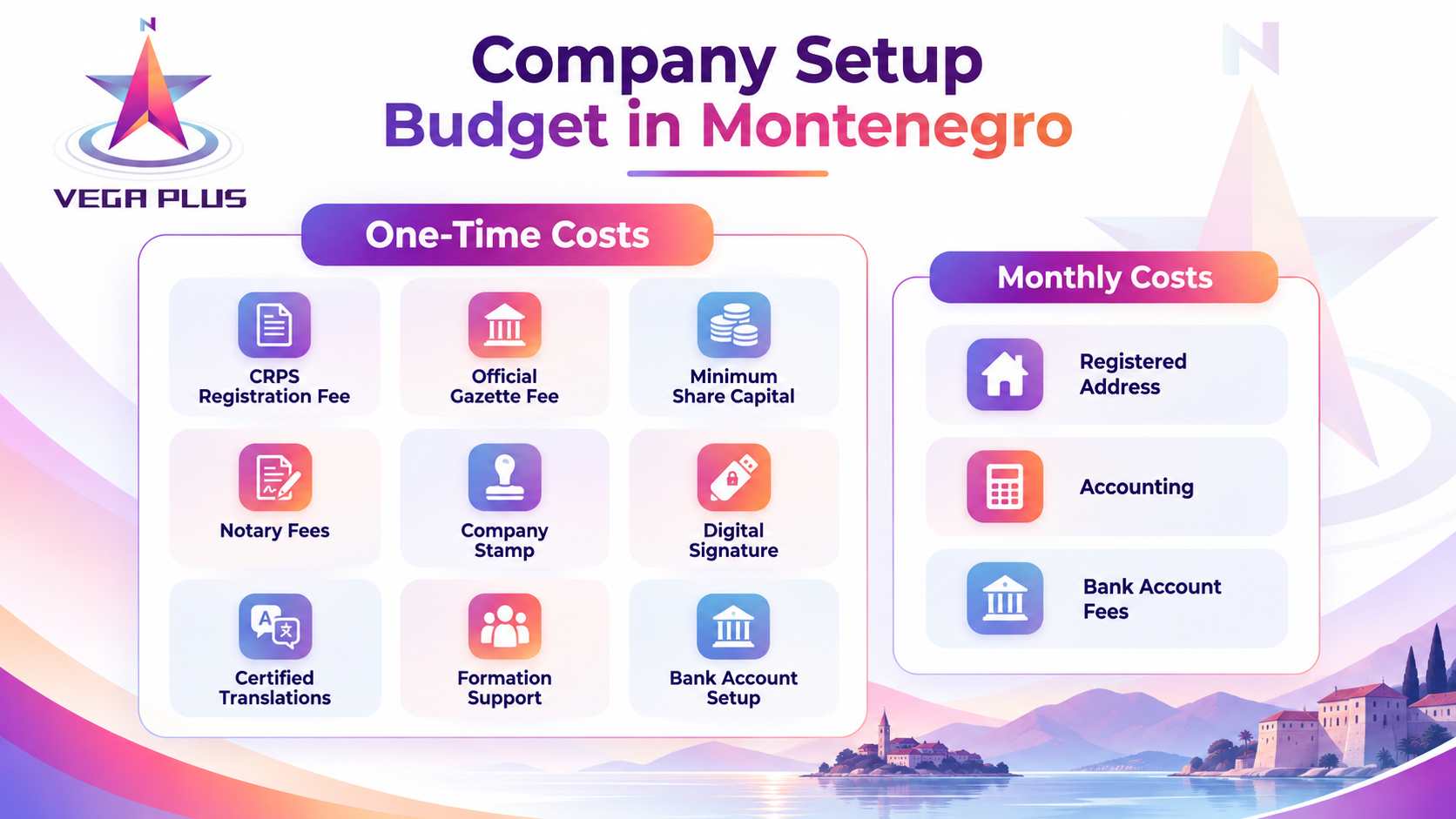
The mandatory government fees to form a DOO in Montenegro are remarkably low. They come to approximately €22, made up of a €10 registration fee paid to the Central Register of Business Entities (CRPS) and a €12 announcement fee for the Official Gazette. The ePorezi.me company formation guide confirms the €10 CRPS fee and the €1 minimum share capital.
Foreign founders, however, should budget between €600 and €2,500 all in for their first year. Real operations require spending on notarisation, certified translations, a corporate bank account and local professional help.
Here is how the typical one time and recurring costs line up:
| Cost item | Typical amount | Paid |
| CRPS registration fee (DOO) | €10 | Once |
| Official Gazette announcement fee | €12 | Once |
| Minimum share capital | €1 (more recommended) | Once |
| Notary fees | €50 to €300 (varies by document volume) | Once |
| Official company stamp | €20 to €50 | Optional |
| Digital signature token (electronic filing and e-invoices) | €30 to €110 | Once |
| Certified translations | €30 to €200 | Once, foreign documents only |
| Professional formation support | €500 to €2,000 | Once |
| Bank account | Free to about €5, plus small monthly fees | Once and monthly |
| Registered address | From about €50 to €280 per month | Monthly |
| Accounting | €50 to €150 per month | Monthly |
The official fees are fixed by regulation. Everything else comes from market practice, so treat those figures as ranges rather than price tags. The digital signature token deserves a special mention: since filings and e-invoicing in Montenegro increasingly run electronically, most active companies need one sooner or later.
Government Fees for Registering a Company in Montenegro
People often expect the state to be the expensive part. In Montenegro, it is the cheapest. The fees you pay directly to public institutions add up to less than a restaurant dinner in Budva.
CRPS Registration Fee and the IRMS Portal
The CRPS charges €10 for registering a DOO and €50 for a joint stock company. Since 2026, registration applications are submitted electronically through the IRMS portal, which replaced the older eFirma system, or in person at the CRPS office. The tax identification number is assigned automatically once the company is registered, and the registration decision usually arrives within four to seven business days.
Official Gazette Announcement Fee
Every new company is announced in the Official Gazette of Montenegro, and the announcement fee is around €12. Together with the CRPS fee, the full state bill for a standard DOO comes to approximately €22.
Share Capital for a Montenegrin DOO
The one euro is real. A DOO needs at least €1 in founding capital and can have between 1 and 30 members, individuals or legal entities, local or foreign. A joint stock company requires at least €25,000.
Still, a company with one euro in capital sends a certain signal. Banks, landlords and suppliers look at your paperwork, and a symbolic capital can make a bank’s compliance team ask more questions. Many founders deposit a few hundred or a few thousand euros simply to look credible. The money remains the company’s working capital, so it is an investment rather than a fee.
Notary and Translation Costs for Foreign Founders in Montenegro
Two founders registering the same type of company can end up with very different bills. A Montenegrin citizen with a local ID often needs one notary visit. A founder from Germany, Turkey or the United States may need powers of attorney, certified copies, translations and apostilles before the file is even complete.
Notary Fees in Montenegro
The founding act and bylaws must be certified by a notary, along with the director’s signature. Notary fees range from €50 to €300, and the final amount depends on document volume: every extra signature, power of attorney or certified copy adds to the total.
The Law on Companies also allows a DOO to be founded electronically, without the founder being physically present, provided all documents are signed in line with the rules on electronic signatures and electronic documents. With a qualified electronic signature, paper and notary costs drop considerably.
Certified Translations and Apostilles
Foreign founders need a certified translation of their passport, and foreign corporate founders need translated commercial register extracts and board resolutions, usually with an apostille from their home country. Certified translations cost €30 to €200, depending on how many documents are involved. Apostille fees are set by your own country’s authorities.
Here is where good preparation pays off. When the VegaPlus company formation team prepares a file, we tell you exactly which documents need translation and apostille before you order anything, so you avoid paying twice for a document issued in the wrong form.
Professional Formation Services in Montenegro

Hiring help is optional, and plenty of locals register companies on their own. For a non-resident, though, professional support often saves more than it costs, mostly in time, travel and avoided mistakes. Market prices for formation support typically range from €500 to €2,000, and the difference usually comes down to what is included.
What a Full Service Formation Includes
A cheap quote that covers only the CRPS filing can turn expensive once translations, the address and the bank are added separately.
VegaPlus handles company formation from start to finish, including:
- Structure selection: Advice on whether a DOO, a holding structure or a branch of a foreign company fits your plans and tax position.
- Documentation and registration: Drafting the founding act and statute, coordinating notarisation and filing through the official channels.
- Tax ID and VAT registration: Making sure your company is set up correctly with the tax authorities from the first day.
- Registered business address: A compliant Montenegrin address, so you do not need to rent an office before you are ready.
- Bank account assistance: Help preparing the file for the bank’s compliance checks.
Founders who plan to live in Montenegro can also get residence permit support through the same team, which keeps the company and immigration paperwork aligned instead of split between two separate offices.
Questions to Ask Any Formation Provider
Whoever you choose, ask for a written list of what the price covers, which government fees are included, and what happens after registration. A provider who stays with you for accounting and compliance has every reason to set your company up properly, because they will be working with it for years.
Company formation is only the first step, and the legal side of running a business deserves the same attention. Beyond registration, VegaPlus offers practical legal support that protects founders once the company starts operating, from drafting and reviewing contracts to preparing shareholder agreements and corporate documentation. The team also advises on labour law when you hire your first employees and represents your company before Montenegrin institutions.
Keeping formation, legal guidance and compliance with one team means fewer handovers, fewer surprises and a company that is properly set up for its first contracts, not just its first filing.
Opening a Business Bank Account in Montenegro

The bank account is cheap in euros and expensive in patience. Most Montenegrin banks open accounts free of charge or for a few euros, and monthly maintenance usually costs only a few euros. Business packages with e-banking and cards cost slightly more.
The real cost lies in compliance. Banks run KYC checks on every founder and director, and foreign ownership usually means more questions about the source of funds and the planned business activity. In many cases the director also needs to visit a branch in person, which means flights and accommodation if you live abroad.
A well prepared file is the best way to shorten the process. VegaPlus helps founders assemble the documents banks typically request and coordinates the appointment, so the visit to the branch is one trip instead of three.
Ongoing Costs of Running a Company in Montenegro
The day your registration decision arrives, the meter starts running. Recurring costs are what separate a cheap formation from a cheap company, so plan for them before you file:
- Accounting: Every Montenegrin company must keep books and file tax returns, even if it earns nothing. A monthly fee of €50 to €150 is common for a small company, and VegaPlus accounting services cover bookkeeping, payroll and employee registration, monthly and annual reporting, tax returns and ongoing compliance monitoring.
- Registered address: Your company needs an official address in Montenegro, which rented office space covers automatically. Otherwise, address services range from around €50 to about €280 per month for serviced packages in coastal towns.
- Bank fees: Account maintenance usually costs only a few euros per month. International transfers and business packages with cards and e-banking can add a little more.
- Corporate income tax: Profit is taxed progressively at 9% up to €100,000, 12% on the portion up to €1.5 million, and 15% above that.
- VAT: The standard rate is 21%, with reduced rates of 15% and 7%. Registration becomes mandatory once turnover exceeds €30,000, and companies can also register voluntarily.
- Dividend tax: When you take profit out of the company, dividends generally face a 15% withholding tax, which may change under double tax treaties.
Sample Company Formation Budgets in Montenegro
Numbers make more sense attached to real situations. The estimates below combine the official fees with the typical market ranges quoted above.
| Founder profile | First year one time costs | Monthly costs |
| Local founder, files alone, one euro capital | About €80 to €210 | Accounting €50 to €150 |
| Foreign individual with professional support | About €600 to €2,000 | Accounting plus address, about €100 to €300 |
| Foreign company founding a subsidiary | Up to about €2,500 | Accounting plus address, often €150 to €400 |
The biggest swing factors are the number of foreign documents, whether you need representation, and where you want your address. A single founder with a local ID and a qualified e-signature can keep costs remarkably low. A multinational structure with apostilled board resolutions cannot, and that is exactly the kind of file where a coordinated team saves the most money.
FAQ
The smartest move is to see the full picture before you start. If you want a clear cost estimate for your own situation, schedule a consultation with VegaPlus or write to hello@vegaplus.me. The team will review your plans, list every cost upfront and take your company from the first document to its first tax return.