

Hiring employees in Montenegro costs an employer about 1% on top of the gross salary, which is one of the lowest figures in Europe. Employer pension and health contributions have been abolished, so most deductions come out of the employee’s gross pay: 10.5% in social contributions, plus progressive income tax and a municipal surtax. The net minimum wage is €600 for jobs requiring up to secondary education and €800 for jobs requiring higher education.
A Montenegrin company is the usual way for foreign founders to employ staff in the country. Our business setup team selects the legal structure, registers the company, obtains your tax ID and VAT number, and coordinates with banks and authorities. Once that is done, your company is ready to sign its first employment contract.
Key Takeaways
- Employers in Montenegro pay roughly 1% of gross salary in contributions, mainly unemployment insurance and small statutory levies.
- Employees give up 10.5% of gross pay in contributions, and income tax starts only above €700 gross a month.
- The net minimum wage is €600 for jobs up to qualification level V and €800 for level VI and above.
- Contracts must be in writing and in Montenegrin, and the employee must be registered before work starts.
- Overtime and night work earn at least 40% extra, and work on a public holiday earns 150% extra.
- Foreign hires need an integrated residence and work permit from a 2026 quota of 28,988 permits.
What Does It Cost to Hire an Employee in Montenegro?

Gross salary makes up nearly all of the cost. Employer health contributions ended in January 2022, and the employer pension contribution dropped to 0% from 1 October 2024 under the “Europe Now 2” programme. Employer obligations that once exceeded 10% of gross pay are now close to a rounding error.
| Contribution | Employer | Employee |
| Pension and disability insurance | 0% | 10% |
| Health insurance | 0% | 0% |
| Unemployment insurance | 0.5% | 0.5% |
| Labour Fund | 0.2% | 0% |
| Chamber of Economy levy | 0.27% | 0% |
| Total | about 1% | 10.5% |
Income tax on salaries is progressive and charged on monthly gross pay: the first €700 is tax free, the part between €700 and €1,000 is taxed at 9%, and anything above €1,000 at 15%. The latest amendments to the personal income tax law appear in the Official Gazette of Montenegro. Each municipality then adds a surtax on the tax amount, most commonly 13%, with rates ranging from about 10% to 15%.
A worked salary example
Here is a gross monthly salary of €1,200 for an employee in a municipality with a 13% surtax. The table shows both the employee’s take-home pay and the employer’s total cost:
| Item | Amount |
| Gross salary | €1,200.00 |
| Employee contributions (10.5%) | €126.00 |
| Income tax (9% on €300 + 15% on €200) | €57.00 |
| Municipal surtax (13% of tax) | €7.41 |
| Net salary | €1,009.59 |
| Employer contributions and levies | €11.64 |
| Total employer cost | about €1,211.64 |
Our accounting and payroll service handles those calculations every month, along with employee registration, monthly reporting and ongoing compliance checks. A payroll error usually comes back later as a penalty or a correction filing. Getting it right from the first month is cheaper.
Minimum Wage and Salary Premiums
The minimum wage depends on the education the job requires, not on the education the employee holds. The net minimum is €600 for positions up to qualification level V and €800 for level VI and above, or roughly €670 and €919 gross. Allowances for meals, travel or housing are paid separately and do not count toward the minimum.
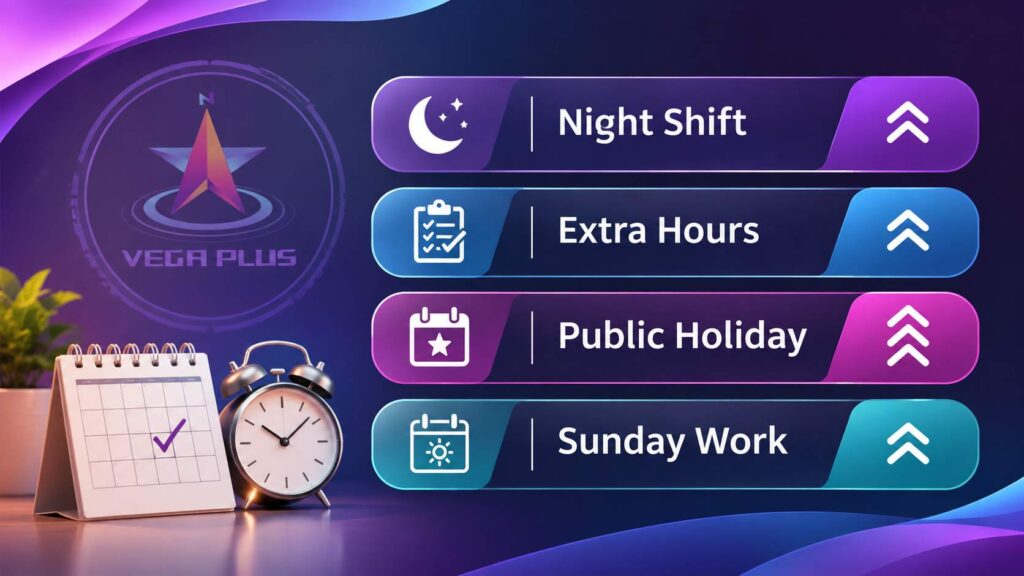
The General Collective Agreement applies to all employers and sets minimum premiums on hourly base pay. Hospitality businesses feel those rules most, because evening, Sunday and holiday shifts are routine there:
| Type of work | Minimum premium |
| Night work (22:00 to 06:00) | 40% |
| Overtime | 40% |
| State or religious holiday | 150% |
| Sunday | 80% (excludes shift work, hotels and public transport) |
Premiums add up when several conditions apply at once. The agreement also adds a length-of-service increase of 0.5% per year of service up to 10 years, 0.75% per year from 10 to 20 years, and 1% per year beyond 20.
How to Hire an Employee in Montenegro
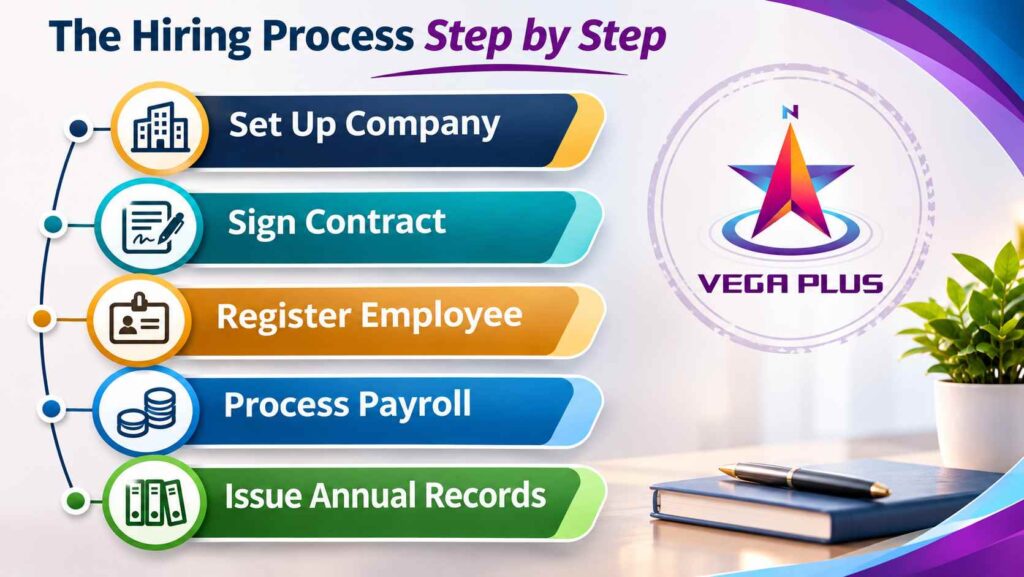
Hiring employees in Montenegro follows a fixed order, and each step depends on the one before it.
For a company with its own Montenegrin entity, the route looks like this:
- Register a Montenegrin company. Our guides to registering a company as a foreigner and company formation costs cover that stage.
- Prepare the contract. It must be in writing, in Montenegrin (bilingual is fine), and signed before work begins.
- Register the employee with the Revenue and Customs Administration before the first working day.
- Run monthly payroll in euros through a bank account and file the IOPPD return for each employee.
- Issue annual statements of income, tax and contributions, and keep employment records for inspections.
If work starts without a signed contract, the law treats the relationship as indefinite employment. Labour inspectors check for exactly that, especially during the summer season.
Contracts, Probation and Working Time
Indefinite contracts are the default. Fixed-term contracts need an objective reason, such as seasonal work or replacing an absent employee, and cannot exceed 36 months in total with the same person. Probation can last up to six months, cannot be extended and must be agreed in the contract.
Full-time work means 40 hours a week, usually eight hours a day from Monday to Friday, with at least 24 consecutive hours of weekly rest. Overtime must be ordered in writing and is capped at 10 hours a week. Average working time cannot exceed 48 hours a week over four months, and a collective agreement may set an annual limit of 250 overtime hours.
Leave, Sick Pay and Public Holidays
Paid annual leave is at least 20 working days a year. The General Collective Agreement adds one to five extra days depending on length of service, and more for employees with disabilities and single parents. Maternity and parental leave lasts up to 365 days from birth, and the mother must use at least the first 98 days.
The employer pays salary compensation for the first 60 days of sick leave, after which the Health Insurance Fund takes over. Compensation is at least 70% of the calculation base and 100% for workplace injuries, occupational illness and pregnancy-related leave. Public holidays include New Year, Labour Day, Independence Day and Statehood Day (two days each), plus religious holidays employees take according to their faith.
Hiring Foreign Nationals
Foreign citizens generally need an integrated temporary residence and work permit, which the employer applies for through the Ministry of Interior. The permit is usually tied to one employer and position. Amendments to the Law on Foreigners in force since 17 January 2026 eased access for IT and healthcare workers.
Permits come from an annual quota, and for 2026 the Government set it at 28,988 permits, mostly for hospitality and construction. Executive directors, entrepreneurs and university-educated managers are exempt from the quota. Employers must notify the Ministry within three days if a foreign worker does not start the job, and within eight days if employment ends early.
Our residency and permit team prepares and submits applications, coordinates work authorization and handles renewals.
Founders can also read how residency links to company formation. Starting the permit early keeps the hiring date realistic.
Ending Employment

Employers can terminate a contract only on grounds listed in the Labour Law. Before dismissing someone for performance or conduct, the employer must give a written warning with reasons and evidence, plus at least five working days to respond. Sick leave, pregnancy, parental leave and union activity can never be grounds for dismissal.
The regular notice period is at least 30 days unless the contract or a collective agreement says otherwise. Redundancy severance grows with years of service under the Labour Law. On retirement, the employee receives at least three minimum net salaries.
What Could Change in 2027?
On 17 September 2026 the Government approved a six-law package called the “Euro model”, planned from 1 January 2027. It would abolish the employee pension and unemployment contributions, remove the 15% income tax band and raise net minimum wages to €1,000, €1,250 and €1,400, as reported by CdM.
As of late November 2026, Parliament has not yet adopted the bills, and employers have pushed back on the higher minimums. Current rates apply until the laws are published. Our tax advisory team can model your 2027 salary costs under both scenarios and adjust profit and dividend planning once the final rules are known.
FAQ
Conclusion
With the Euro model still pending, plan 2027 budgets with both scenarios in mind. If you need help with company setup, payroll or permits, contact our team and we will help you hire employees in Montenegro correctly from the first contract onward.