
Most small businesses in Montenegro can leave VAT alone on day one. VAT registration in Montenegro becomes mandatory once taxable turnover passes €30,000 over the previous 12 months, and the application is then due by the 20th of the following month. Below that line, registration is optional, though choosing it voluntarily keeps you in the system for at least three years.
The question gets more interesting for people who moved here to work online. Many founders look into Montenegro tax residency for remote workers first and only later discover that VAT runs on its own rules, tied to the business and its turnover. A freelancer invoicing clients in Berlin and a café owner in Budva can face very different obligations on similar income.
Sorting out VAT at the right moment is part of our business setup work. We help clients choose a legal structure, register the company, obtain a tax ID and complete VAT registration when it becomes necessary. Afterwards, we stay on top of compliance, so the tax side never catches you off guard.
Key Takeaways
- VAT registration in Montenegro is mandatory once taxable turnover exceeds €30,000 within the previous 12 months.
- The PR-PDV application is due by the 20th day of the month after you cross the threshold.
- Businesses below the threshold may register voluntarily but must stay in the system for at least three years.
- Your VAT number is your existing PIB with the prefix ME, usually issued within seven days.
- VAT returns are filed monthly, with filing and payment due by the 15th of the following month.
- Remote employees of foreign companies on a Digital Nomad permit usually have no VAT duties of their own.
When Is VAT Registration in Montenegro Mandatory?
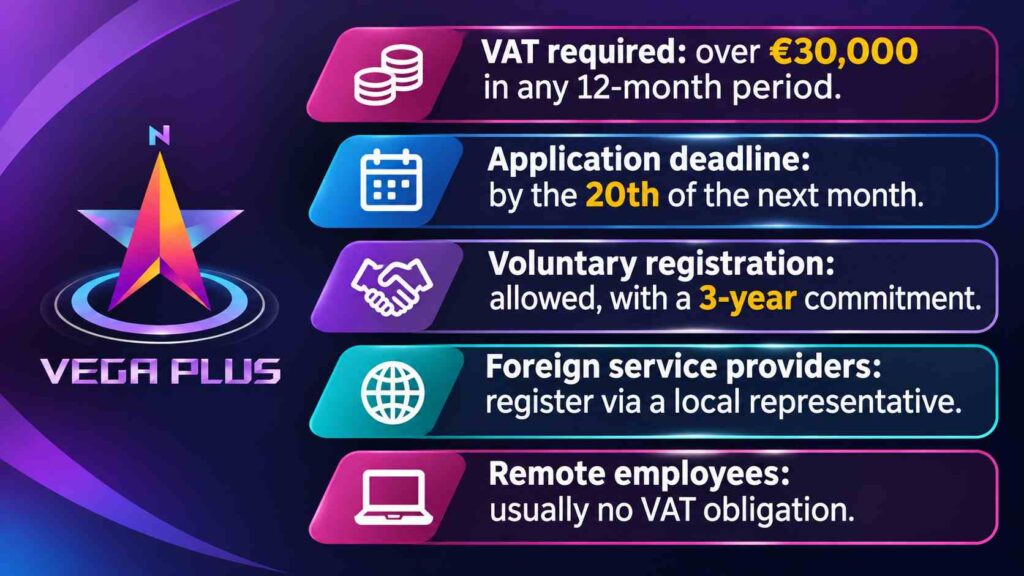
A business must register once its taxable turnover exceeds €30,000 in the previous 12 months. The test runs on a rolling basis, so you look back over any 12 consecutive months and the calendar year plays no part. A guesthouse earning most of its income between June and September can cross the line in a single summer.
Tracking the figure month by month is the simplest protection, and our tax advisory team watches it for clients who are getting close. When the numbers point toward registration, we prepare the paperwork before the deadline arrives. You then have time to update invoices and contracts calmly.
Crossing the €30,000 threshold
The Tax Administration (Poreska uprava) sets the deadline in its official VAT guide: form PR-PDV must be filed by the 20th day of the month after the threshold was exceeded. Some accounting firms mention a 10 day window based on local practice; the date in the official guide is the 20th. If you miss it, the Tax Administration can register you ex officio and assess VAT for the period you should already have been charging it.
Registering voluntarily
Any business can register at any time, whatever its turnover. The catch is commitment, since voluntary registration keeps you in the VAT system for at least three years. It often pays off for companies with heavy startup costs, because registered taxpayers can deduct input VAT on business purchases.
The table sums up where common situations land.
| Situation | VAT registration | What to keep in mind |
| Turnover above €30,000 in 12 months | Mandatory | Apply by the 20th of the following month |
| Turnover at or below €30,000 | Voluntary | Minimum three years in the system |
| Foreign company selling services to local consumers | Required through a tax representative | Applies from the first sale |
| Remote employee of a foreign company | Usually none | Personal tax depends on residency |
Not sure where you stand? The quick check below follows the same logic:
A simplified guide based on the Tax Administration’s VAT guide. Mixed situations need an individual check.
Montenegro Tax Residency for Remote Workers and Where VAT Fits In

Two separate questions often get blended together here. Tax residency concerns personal income tax, while VAT concerns the supplies a business makes. According to PwC’s tax summaries, an individual becomes resident by spending at least 183 days in Montenegro in a tax year, or by having a domicile or centre of interests here.
If you work for an employer registered abroad on a Digital Nomad permit, you make no taxable supplies in Montenegro, so there is nothing to register for. The Law on Personal Income Tax also exempts permit holders from income tax on that foreign income. Our residency services cover the permit from eligibility assessment to renewal.
The picture changes once you open a Montenegrin company and invoice clients yourself. Services sold to businesses established abroad are taxed at the client’s seat, so those invoices go out without Montenegrin VAT, while local clients bring the €30,000 test into play. If the company does not exist yet, our guide on registering a company in Montenegro as a foreigner covers the steps first.
How VAT Registration in Montenegro Works, Step by Step
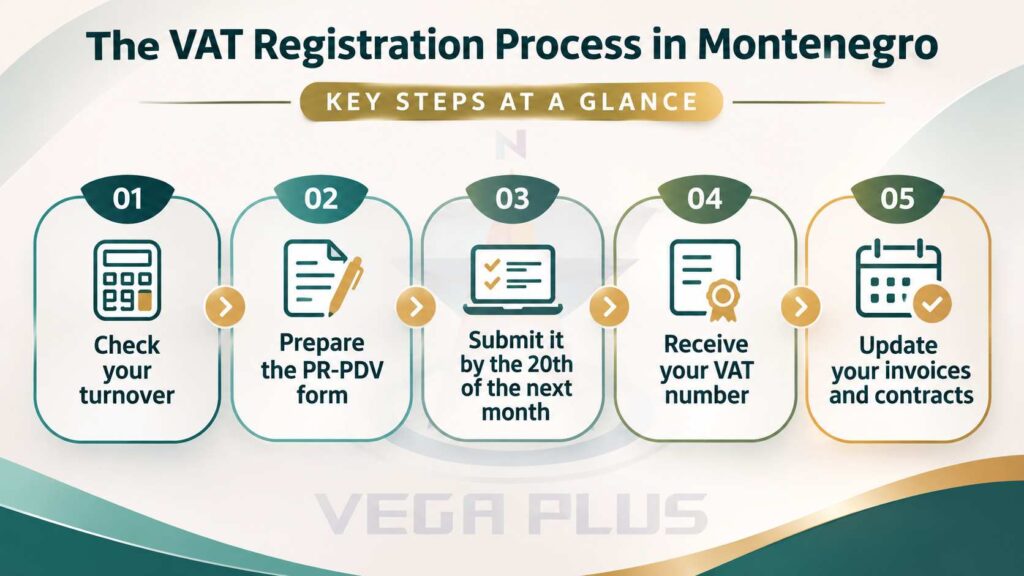
The procedure is short, provided your company already exists and has a PIB. Most of the effort goes into giving accurate details about your activity and the date the obligation arose.
The usual order looks like this:
- Confirm that taxable turnover has passed €30,000, or decide to register voluntarily.
- Complete form PR-PDV with company details, main activity and the date the threshold was crossed.
- Submit the application to the Tax Administration, yourself or through an authorised representative.
- Start charging VAT from the date stated in the registration decision.
- Update invoices, fiscal cash registers and accounting software with your VAT number.
What you receive and how quickly
The Tax Administration issues its decision within seven days of receiving the application. Your VAT identifier is your existing PIB with the prefix ME, so no separate number is created. The same ID then appears on every invoice and return.
Foreign businesses without a local company
For non-residents, VAT registration in Montenegro follows a different route. From 6 February 2026, foreign service providers selling to private consumers must establish a permanent presence or appoint a tax representative, as RegFollower reported. The representative shares liability for the VAT, and such registrations take longer because home country documents need an apostille.
Which VAT Rates Apply After Registration?

After VAT registration in Montenegro, you charge VAT at the rate attached to each supply. The standard rate is 21%, and three lower rates cover specific goods and services, as listed in PwC’s Montenegro tax summary. The examples below show where typical supplies fall.
| Rate | What it covers | Examples |
| 21% | Most goods and services | Consulting, software, alcohol and coffee in restaurants |
| 15% | Selected hospitality and culture | Hotel stays, restaurant food, books, event tickets |
| 7% | Everyday essentials | Bread, milk, flour, medicines, schoolbooks, public transport |
| 0% | Exports and international supplies | Exported goods, international transport, free zones |
Rates as listed in PwC Worldwide Tax Summaries. Financial, insurance, healthcare and most real estate services are exempt.
A café menu shows how detailed the split can get. The sandwich sits at 15%, while the espresso next to it stays at 21%. Financial, insurance, healthcare and most real estate services are exempt altogether, and the input VAT linked to them cannot be deducted.
Life After Registration: Returns and Refunds
Measured over any 12 consecutive months, not the calendar year.
Yourself or through an authorised representative.
Your VAT ID is your existing PIB with the prefix ME.
From the date in the decision. Update invoices, fiscal registers and software.
Filed electronically with payment, even in a month with zero sales.
30 days for predominant exporters and taxpayers with more than three consecutive credit periods.
Registration starts a monthly routine. The PR PDV-2 return and payment are due electronically by the 15th of the following month, even in a month with zero sales.
Our accounting team handles bookkeeping, monthly reporting and tax returns, so the 15th never turns into a scramble. If input VAT exceeds output VAT, the difference is refundable within 60 days. Predominant exporters and taxpayers with more than three consecutive credit periods get their refund within 30 days.
Frequently Asked Questions
If you would like someone to check your numbers or handle the registration, get in touch with our team. We can look at your client mix and confirm whether registration makes sense now. If it does, we prepare everything before the deadline.
Sources and legal references
- Tax Administration of Montenegro (ePorezi) – Official VAT guide
- RegFollower – Montenegro Parliament revises VAT law
- PwC Worldwide Tax Summaries – Montenegro, other taxes (VAT)
- Official Gazette of Montenegro – Law on Value Added Tax
This guide is general information, not legal or tax advice for your specific situation. Rules change, so confirm the details with us or a licensed advisor before you act.