

Almost everyone opening a business in Montenegro chooses between two forms: the sole proprietor, known locally as a preduzetnik, and the limited liability company, or D.O.O. (društvo sa ograničenom odgovornošću).
Sole proprietor suits a resident working alone on low risk projects with modest turnover, while a D.O.O. makes more sense once you want to protect your personal assets, hire people, grow, or apply for residency as a foreign founder.
Surprisingly, money rarely tips the scale, since a D.O.O. needs just €1 of share capital. The real decision comes down to who carries the risk and how profit reaches your pocket. Paperwork matters too, and it differs more than most founders expect.
VegaPlus treats the choice of legal form as the first step of every business setup. We help founders select the structure, register the company, coordinate with banks and authorities, and obtain a tax ID and VAT number. After registration, our team stays close with compliance guidance, so the first months run without surprises.
Key Takeaways
- A preduzetnik owner answers for business debts with all personal property.
- A D.O.O. needs only €1 of capital and keeps private assets apart from company debts.
- Sole proprietors pay personal income tax of 0%, 9% or 15%, or a lump sum below €30,000 turnover.
- A D.O.O. pays 9% tax on profit up to €100,000, plus 15% on dividends paid out.
- Both forms must register for VAT once turnover passes €30,000 in any 12 month period.
- Foreign founders usually pick a D.O.O., since it can support a temporary residence permit.
Sole Proprietor and LLC in Montenegro Side by Side

Both forms are registered in the Central Register of Business Entities (CRPS), and with correct documents the process typically takes four to five working days. After that, the paths split quickly. The table below sets out the differences that matter most in daily business.
| Feature | Sole Proprietor (Preduzetnik) | Limited Liability Company (D.O.O.) |
| Legal status | Natural person | Separate legal entity |
| Owners | One | One to 30 members |
| Minimum capital | None | €1 |
| Liability | Unlimited, personal assets are at risk | Limited to the company’s own assets |
| Tax on income | Personal income tax at 0%, 9% or 15% | Corporate income tax at 9%, 12% or 15% |
| Taking money out | Profit is already personal income | Director’s salary or dividends (15% tax) |
| Lump sum taxation | Possible below €30,000 annual turnover | Not available |
| Bookkeeping | Lighter, depending on tax regime | Full books and annual statements |
| Best for | Local solo workers, freelancers, testing an idea | Growing businesses, teams, foreign founders |
The real gap opens over time, in the administrative work each form creates and in who pays when something goes wrong.
That is where professional accounting services in Montenegro earn their keep, since monthly reporting, payroll and tax returns look very different for the two structures.
If you want to see what registration itself involves, our guide to company formation costs in Montenegro breaks it down step by step. Registration fees are modest for both forms, so the long term obligations deserve more of your attention.
- You trade as a natural person
- Unlimited liability: savings, car and home are at risk
- No share capital
- Personal income tax 0% / 9% / 15%, or lump sum below €30,000
- Lighter bookkeeping
- Best for local, low-risk solo work
- Separate legal entity with 1 to 30 members
- Liability limited to company assets
- €1 share capital
- Corporate tax 9% / 12% / 15%, plus 15% on dividends
- Full books and annual statements by 31 March
- Best for growth, teams and foreign founders seeking residency
Summary of the comparison table above.
How the Sole Proprietor Works in Practice
Legally, a preduzetnik is you, trading under a registered name. Montenegro’s Law on Business Organisations treats the sole proprietor as a natural person who runs a business activity for profit, and the owner stays responsible for every business obligation.
Setup is quick and running costs stay low, which explains why freelancers and small local service providers like the form.
Where it works well
For a translator, a tour guide or a small repair workshop, the preduzetnik has real advantages. Starting costs stay close to zero and the rules are easy to follow.
Here are the main ones:
- No share capital to deposit before you start trading.
- Profit is already your personal income, so there is no separate dividend step.
- Lump sum taxation (paušal) is open to most activities while annual turnover stays below €30,000.
- Closing down only takes deregistration and final returns.
Everyone else pays personal income tax on actual income: 0% up to €8,400 a year, 9% between €8,400.01 and €12,000, and 15% above that, plus a municipal surtax.
Montenegro has no separate health insurance contribution, and the pension contribution paid by the insured person is 10% under the law on compulsory social insurance contributions. For entrepreneurs, contributions are calculated on a base tied to turnover, income and the previous year’s average salary, so they belong in your budget from the very first month.
Where it gets risky
Unlimited liability sounds abstract until a supplier files a claim or a tax bill arrives after a bad year. As a preduzetnik, whatever you owe can be collected from your savings, your car and even your home.
A freelance photographer who damages rented equipment during a wedding season has no company standing between them and the rental firm, so the claim goes straight to their personal finances.
Growth brings its own limits. A preduzetnik is registered for a specific activity, and banks tend to look harder at cross border payments. International B2B clients also often prefer to sign with a company.
How a D.O.O. Works
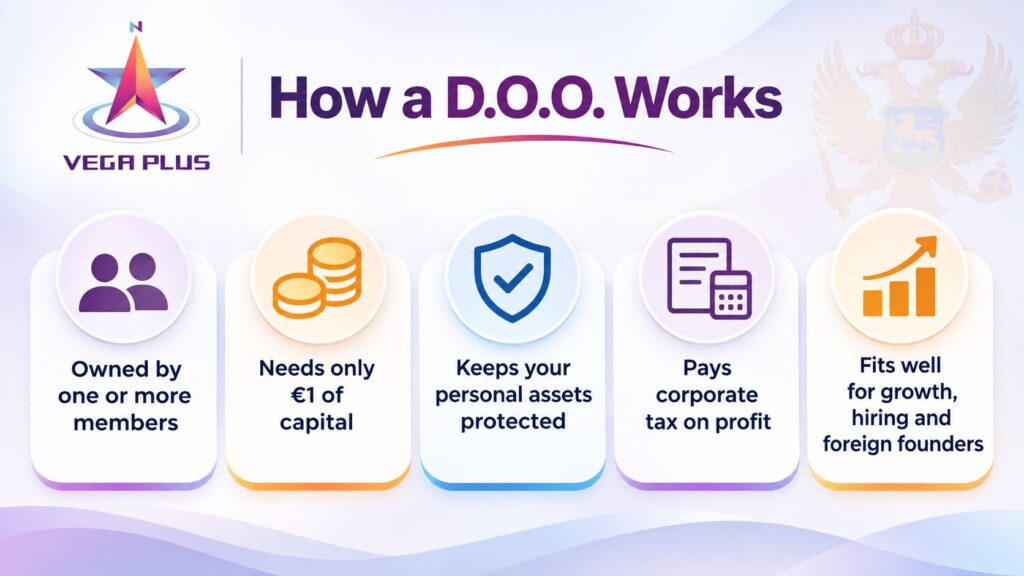
A D.O.O. is a separate legal entity that owns its assets and answers for its own debts. It can have between one and 30 members, and every company needs an executive director, a role the sole owner can fill personally. Most foreign founders in Montenegro choose it, and the details explain why.
Liability and asset protection
The company is liable for its obligations with all of its property, while members are generally not personally liable for company debts. The protection has limits, though. Montenegrin law allows creditors to reach members personally when they abuse the company form, for example by mixing private and company money or using the company to escape obligations.
Clean books and a separate corporate account keep that shield intact. Opening the account comes right after registration, and our article on opening a business bank account in Montenegro explains what banks usually ask for.
Keeping company payments and private spending strictly apart from the first day costs nothing and saves a lot of trouble later.
Taxes on profit and dividends
Corporate income tax in Montenegro is progressive, and the rate depends on how much taxable profit the company makes. Most small companies stay in the first band. The brackets look like this in practice:
| Annual taxable profit | Tax rate | How the tax is calculated |
| Up to €100,000 | 9% | 9% of the full profit |
| €100,000.01 to €1,500,000 | 12% | €9,000 plus 12% on the amount above €100,000 |
| Above €1,500,000 | 15% | €177,000 plus 15% on the amount above €1,500,000 |
Getting money out is where many founders get a surprise. Profit paid to owners as a dividend is taxed again, at 15%. Here is how it adds up for a D.O.O. with €40,000 of taxable profit:
| Step | Calculation | Amount |
| Taxable profit | Starting point | €40,000 |
| Corporate income tax | 9% of €40,000 | €3,600 |
| Profit left for distribution | €40,000 minus €3,600 | €36,400 |
| Dividend tax | 15% of €36,400 | €5,460 |
| Total tax paid | €3,600 plus €5,460 | €9,060 (about 22.7%) |
Our tax advisory team helps owners plan the mix of salary and dividends, so the company stays compliant and the owner keeps more of what the business earns. The right balance depends on your residency status and on how much cash the company needs to keep.
Foreign founders and residency
Foreigners can own 100% of a D.O.O. and serve as its director without a local partner. The company can also be the basis for a temporary residence permit, which is the main reason foreign entrepreneurs rarely choose the sole proprietor route. Our residency and permits service covers eligibility checks, applications and renewals.
Accounting Services in Montenegro: What Each Structure Requires
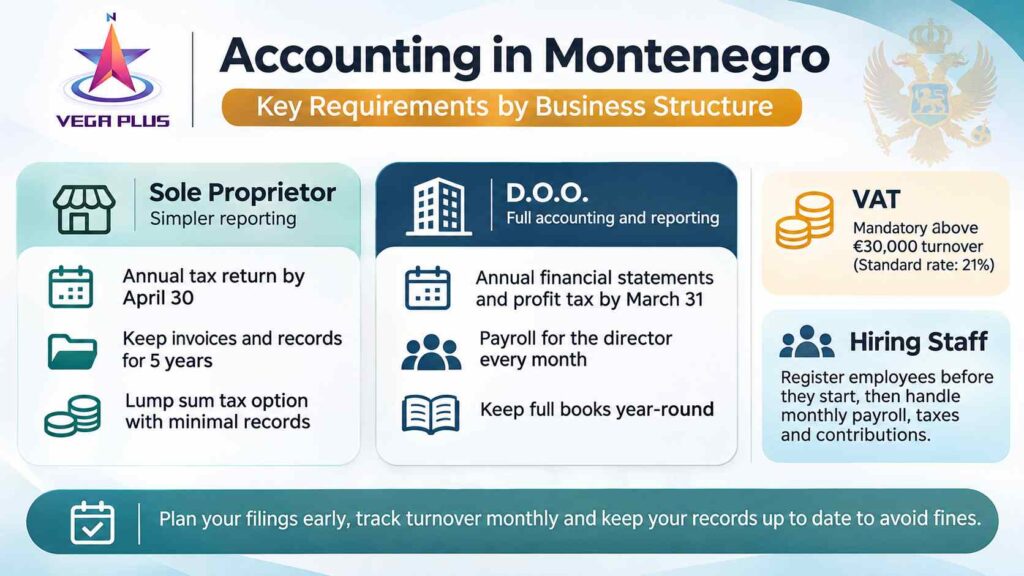
Paperwork is the least exciting part of the decision, and it often settles it. The two forms come with very different reporting obligations. Late filings bring fines either way, so know the calendar in advance.
- For a sole proprietor
A preduzetnik taxed on actual income files an annual personal income tax return by 30 April for the previous year. Invoices, receipts and expense records must be kept for five years and be available for tax inspection. Lump sum taxpayers pay fixed amounts instead, which keeps record keeping light.
- For a D.O.O.
A D.O.O. keeps full books throughout the year. Annual financial statements and the corporate income tax return are both due by 31 March, and payroll for the director runs every month. Every new business also needs a tax identification number, and the Tax Administration’s guide to founding a company explains how registration connects to your tax obligations.
VAT works the same way for both structures. Registration becomes mandatory once taxable turnover exceeds €30,000 over the previous 12 months, the standard rate is 21%, and voluntary registration below the threshold commits you for at least three years. Growing businesses often cross the threshold mid year, so tracking turnover monthly saves a scramble later.
Hiring staff adds one more layer to either form. Employees must be registered before they start work, and the government business portal sets out the steps for registering a company and its employees. Each month the employer then calculates wages, withholds income tax and pays contributions, a routine our accounting team takes over together with bookkeeping and annual reporting.
Which One Should You Choose?
A starting point only. The right form also depends on residency status and how you plan to take money out.
The answer depends on how much risk your work carries, how fast you expect to grow and whether you already live in Montenegro. Answer those honestly and the choice usually makes itself. Use the quick guide below as a starting point.
Choose a sole proprietor if:
- you are a local resident starting a small, low risk service activity;
- you expect modest turnover and want minimal overhead;
- you work alone and have no plans to bring in investors.
Choose a D.O.O. if:
- you want your personal assets kept apart from business debts;
- you plan to hire, take on partners or sign international contracts;
- you are a foreign founder who wants to apply for residency as a director.
Plenty of people start as a preduzetnik to test an idea and incorporate once the numbers justify it. Either way, decide with real figures in front of you. A structure that suits €15,000 a year rarely suits €150,000.
Frequently Asked Questions
Still weighing the two? Contact our team, tell us about your plans, and we will help you choose the structure and keep the accounting in order from the first invoice.
Sources and legal references
- Law on Business Organisations
- law on compulsory social insurance contributions
- Tax Administration’s guide to founding a company
- government business portal
This guide is general information, not legal or tax advice for your specific situation. Rules change, so confirm the details with us or a licensed advisor before you act.