By mid-2026, 97,995 foreigners held temporary or permanent residence in Montenegro, according to official residence data. In a country of a little over 620,000 people, that is roughly one resident in every six or seven. Remote workers are a visible part of that crowd, and most of them eventually ask: does living here mean filing taxes here?
For most digital nomads, the answer is no. If you hold digital nomad residence and your money comes from a foreign employer or your own company registered abroad, Montenegro exempts that income from local personal income tax, so you usually need no local bookkeeping at all. The picture changes the moment you register a business here, and from that day on accounting becomes a legal obligation with fixed deadlines.
Whether you are still a nomad or already running your own DOO, our team at VegaPlus covers the accounting side for you. We handle bookkeeping, payroll and employee registration, monthly and annual reporting, tax returns and ongoing compliance monitoring. Your filings stay on time, and you keep your attention on your clients.
Key Takeaways
- Income from a foreign employer earned under digital nomad status is exempt from personal income tax in Montenegro.
- Pure digital nomads working for foreign entities usually need no local bookkeeping or corporate tax filings.
- Registering as a local entrepreneur or opening a company in Montenegro ends your digital nomad status.
- A Montenegrin company pays progressive corporate tax of 9%, 12% or 15%, depending on annual profit.
- VAT registration becomes mandatory once turnover passes €30,000 in any 12-month period.
- Every registered company, even one with zero turnover, files a profit tax return and financial statements by the end of March.
Do Digital Nomads in Montenegro Need Accounting Services?
In most cases, no. A nomad working for a company outside Montenegro has no Montenegrin payroll, invoices or corporate entity to report on. Your obligations sit with your employer or foreign company, plus whatever your home country expects.
The permit is what makes everything work, so getting it right matters more than finding a bookkeeper. If you have not applied yet, our residency support for digital nomads covers eligibility checks, document preparation, submission and later renewals.
According to the government’s official digital nomad portal, the permit is issued for up to two years and can be extended once for up to two more, and a new one can follow only six months after the previous one expires.
Tax Status and Exemptions for Digital Nomads

The exemption is confirmed in the PwC Worldwide Tax Summaries, last reviewed in August 2026. Income from self-employment or independent activities that a digital nomad earns from an employer not registered in Montenegro is tax-exempt, provided the person holds digital nomad status. Local practitioners add that such income stays outside the Montenegrin contribution system as well.
There is one firm restriction attached. If you register as an entrepreneur or establish a company inside Montenegro, you lose digital nomad status and move to a different framework for both residence and taxation. Many people learn about that rule only after filing registration documents.
Where the 183-Day Rule Comes In
You become a Montenegrin tax resident after 183 days in a calendar year or if your centre of vital interests is here. Residents are, in principle, taxed on worldwide income, and the nomad exemption keeps that rule from turning into a bill. Your home country may still claim you, so check the relevant double taxation treaty early.
When Does the Nomad Exemption Stop Protecting You?
The exemption covers a specific profile: a foreigner working online for foreign companies. Once your activity starts to look local, Montenegrin rules on bookkeeping, payroll and VAT apply in full.
The most common turning points are:
- registering as an entrepreneur (preduzetnik) in Montenegro;
- opening a limited liability company (DOO);
- providing services to companies registered in Montenegro;
- hiring a local employee or assistant.
Opening a company often suits people who plan to stay long term. Our business setup service helps you pick the right structure, register the company, obtain a tax ID and VAT number where needed, and set up a registered address.
The table below shows how your accounting needs shift with each setup.
| Your setup | Montenegrin tax position | Accounting you will need |
| Digital nomad, foreign employer | Income exempt from personal income tax | Usually none locally |
| Digital nomad, own company registered abroad | Exempt while the company is not registered in Montenegro | Bookkeeping in the company’s home country |
| Registered entrepreneur in Montenegro | Taxed on profit; nomad status lost | Local bookkeeping, contributions, annual return |
| Montenegrin DOO with activity | Corporate tax of 9% to 15% | Monthly bookkeeping, payroll, VAT if over threshold |
| Montenegrin DOO with zero turnover | Tax return still required | Annual statements and return by the end of March |
What Accounting Looks Like Once You Own a Montenegrin Company
Running a DOO in Montenegro is fairly manageable, though the calendar is strict. Montenegro has used the euro since 2002 without joining the eurozone, so your books, invoices and tax payments all stay in euros. That alone saves a surprising amount of reconciliation work.
Corporate Profit Tax
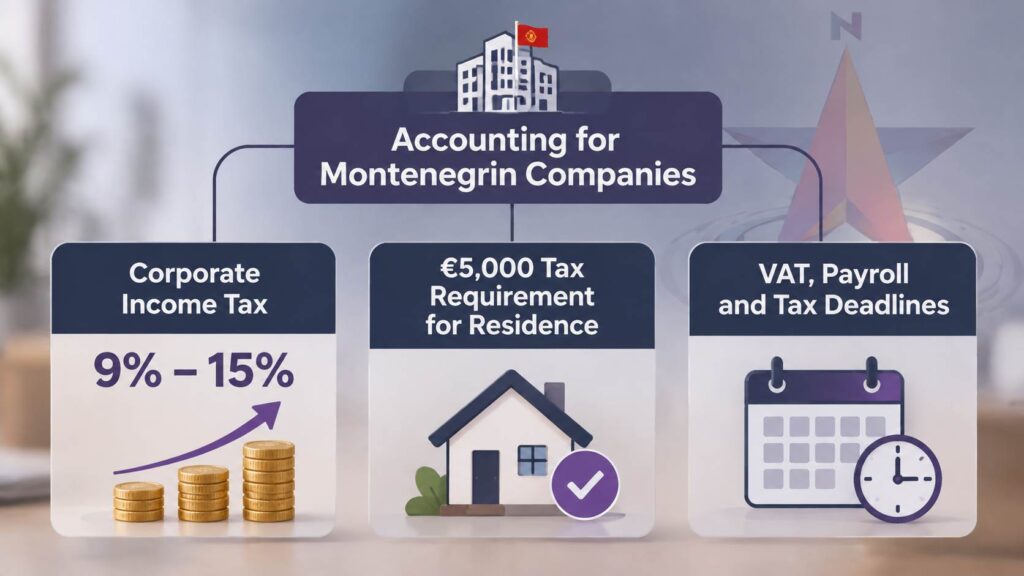
Profit up to €100,000 is taxed at 9%. Between €100,000.01 and €1.5 million, you pay €9,000 plus 12% on the amount above €100,000, and above €1.5 million the tax is €177,000 plus 15% on the excess. For a typical freelancer-sized company, the 9% rate covers everything.
If you are still weighing incorporation, our breakdown of the company formation cost in Montenegro lists the fees and steps involved. The way you pay yourself (salary, dividends or both) changes your total tax burden, so planning pays off.
Our tax advisory team works on corporate and personal tax planning, dividend planning and VAT structuring before the year closes.
The €5,000 Rule for Owners Who Need Residence
Amendments to the Law on Foreigners entered into force on 17 January 2026 and added a financial test for foreign founders. Registered entrepreneurs and directors who own more than 51% of their company can extend their combined residence and work permit only if the business paid at least €5,000 in taxes and contributions in the previous year. Citizens of the EU, Iceland, Liechtenstein, Norway and Switzerland are exempt, so for everyone else accurate payroll now protects the permit too.
VAT, Payroll and Annual Deadlines
VAT registration becomes mandatory once turnover exceeds €30,000 in any 12-month period, counted on a rolling basis. The Montenegrin business portal lists the standard VAT rate at 21%, with a reduced 7% rate for items such as medicines, books and computers.
Once registered, you file and pay VAT monthly, and salaries paid by the company, including your own as director, bring monthly payroll taxes and contributions.
The Tax Administration covers the registration side in its guide to setting up a company, a useful checklist for first-time founders. The big annual date is the end of March, when every company files its corporate tax return and financial statements electronically and pays any tax due.
The rule applies to inactive companies too, so a DOO opened “just in case” still needs an accountant once a year.
How to Choose Accounting Services in Montenegro as a Foreigner
Montenegrin law regulates certified accountants and certified auditors, so ask about qualifications first. Then check practical fit.
A good partner for a foreign founder offers:
- clear communication in English;
- experience with foreign founders and residence permits;
- electronic filing and active deadline tracking;
- support with VAT, payroll, dividends and tax inspections.
Accountants rely on clean bank statements to close the books each month. If you still need an account, our guide to opening a business bank account in Montenegro covers the documents banks usually ask for.
To talk through your case, contact our team and we will tell you which services you actually need.