

One euro. That is the minimum share capital Montenegrin law requires for a limited liability company, and the figure usually surprises founders who come from countries where opening a company means locking away tens of thousands in a bank account. The low entry point matches how open the country is to outside investors.
A foreigner can register a company in Montenegro as the sole owner of a DOO, file the application electronically through the Tax Administration’s IRMS portal and typically receive the registry’s decision within about four business days.
Where foreign entrepreneurs lose time is after registration, when a business bank account, monthly tax filings and a residence permit each follow their own rules.
At VegaPlus, we work with foreign founders from the very first decision. Our business setup team helps you choose between a DOO, a holding or a branch, prepares your founding documents and files the registration with the authorities. We run the whole process in English and stay involved until your company has its tax ID, bank account and registered address in place.
Key Takeaways
- A foreigner can own 100% of a Montenegrin DOO, and the minimum share capital is €1.
- Applications go to the Central Register of Business Entities (CRPS) through the Tax Administration’s IRMS portal, electronically or in person.
- The registry decides within up to four business days, and the tax number is assigned automatically.
- Foreign documents need an apostille and a certified translation before filing.
- Corporate income tax runs at 9%, 12% or 15% depending on profit, and VAT registration becomes mandatory above €30,000 in turnover.
- Owning a company does not give you the right to live or work in Montenegro, which requires a separate residence and work permit.
Which company form suits a foreign founder in Montenegro?
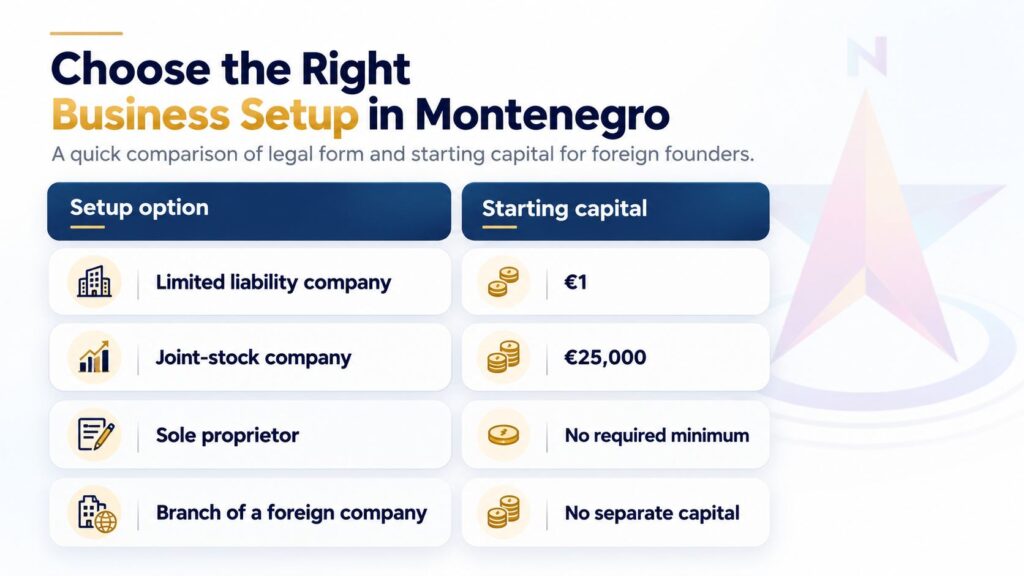
For most foreign entrepreneurs, the right choice is a limited liability company, known locally as a DOO (društvo sa ograničenom odgovornošću). It keeps your personal assets separate from the company’s debts, and it can have a single member or several partners.
Formation is governed by the new Law on Business Organisations, while a separate Law on Registration of Business and Other Entities regulates the procedure itself.
Choosing the form shapes everything that follows, from how profits leave the company to who signs contracts on its behalf. A holding structure, a trading company and a one-person consultancy each call for different founding documents.
The table below compares the main business forms available to foreign founders.
| Business form | Local name | Minimum capital | Liability | Typical fit |
| Limited liability company | d.o.o. | €1 | Limited to the member’s contribution | Startups, consultancies, service companies |
| Joint-stock company | a.d. | €25,000 | Limited to shareholders’ stake | Larger ventures with outside investors |
| Sole proprietor | preduzetnik | None | Unlimited, personal assets at risk | Individuals already living in Montenegro |
| Branch of a foreign company | dio stranog društva | None of its own | Parent company is liable | Established foreign firms entering the market |
How to register a company in Montenegro, step by step
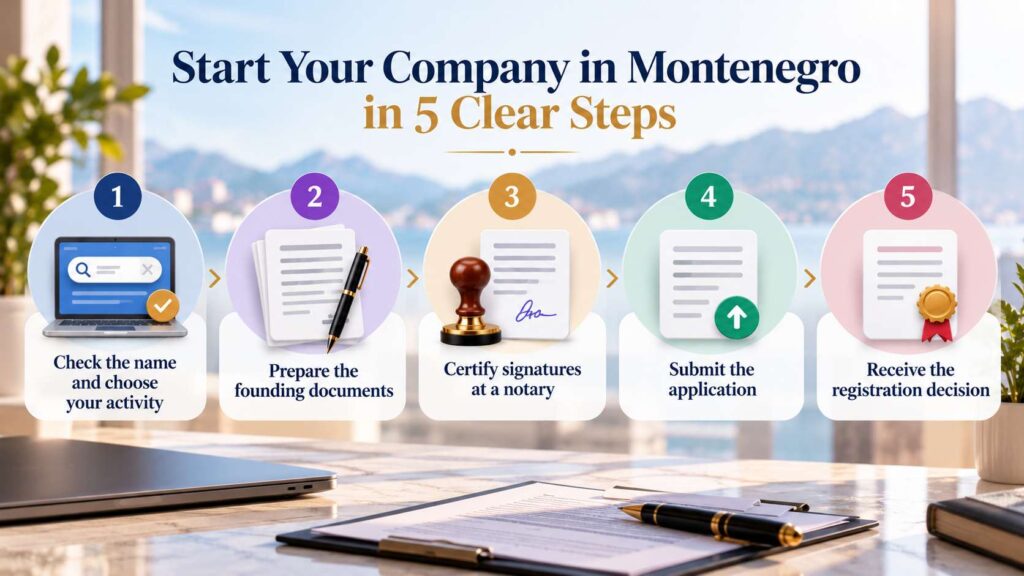
Registration runs through the Central Register of Business Entities (CRPS), which operates within the Tax Administration. You can file through the IRMS portal electronically or submit documents in person. The steps below follow the order the registry expects.
- Check the name and choose your activity.
Start with a free search of the CRPS business register to confirm nobody already uses your preferred name. Foreign founders are often surprised by the language rule: the name must be in Montenegrin or another language in official use, in Latin or Cyrillic script. Its distinctive part may exceptionally be in a foreign language. “Adriatic Code d.o.o. Podgorica” works; a name entirely in English with no local legal form does not. - Prepare the founding act and statute.
A single-member DOO needs a decision on founding, a company with several members needs a founding agreement, and both need a statute. The government guide for SMEs notes that activity codes follow the Law on Classification of Activities, so pick your main activity now. - Certify signatures at a notary.
The founding act is certified and directors’ signatures are verified. The ePorezi formation guide adds that foreign founders need a certified passport translation with an apostille, and it links to official IRMS templates. - Submit the application.
You file the single registration form with the founding documents and proof of paid administrative fees. The state fees are modest, while notaries and translations make up most of the bill, as our breakdown of company formation costs in Montenegro shows. A founder abroad may also appoint a proxy to represent them in the procedure. - Receive the registration decision.
The registry decides within up to four business days, and the tax identification number is assigned automatically. From that day your company legally exists and can sign contracts in its own name.
Documents foreign founders should prepare before filing
Most delays come from an incomplete file rather than from the registry itself.
If one signature lacks certification or a translation is missing, the clock effectively restarts. Have the following ready before you submit anything:
- A copy of each founder’s passport, with apostille and certified translation
- The notarised decision on founding or founding agreement, plus the statute
- Written consent of appointed directors and their personal data
- The main activity, a registered seat address and an email for official correspondence
- Proof of paid administrative fees and, if needed, a power of attorney
Corporate founders should expect extra paperwork, usually proof of the parent company’s registration in its home country. Such documents need to be legalised and translated by a court interpreter. Ordering them early saves weeks.
What happens after the registration decision?
The decision gives the company legal life, though it cannot trade smoothly until a few practical steps are done. First comes a business account at a Montenegrin bank, opened with the registration decision, the founding act and the director’s documents.
Banks run their own due diligence, and our guide to opening a business bank account in Montenegro explains what they ask foreign owners.
If you hire staff, employees are registered with the Tax Administration through the IOPPD return. VAT registration becomes mandatory once turnover exceeds €30,000, and companies may also register voluntarily.
Monthly VAT returns, payroll and annual statements add up quickly, which is why many of our clients hand them to our accounting and payroll team from the first month.
Buying an existing company instead of founding one? Check its status in the register first. Companies registered before 1 January 2026 had to align their founding acts with the new Law on Business Organisations by 15 June 2026, and a company that skipped the step brings that problem with it.
Taxes a new Montenegrin company should plan for
Montenegro uses a progressive corporate income tax, set out in the Law on Corporate Income Tax. The rates remain among the lower ones in Europe, which explains part of the country’s appeal to small international businesses. Profit is taxed by bracket:
| Annual taxable profit | Rate |
| Up to €100,000 | 9% |
| €100,000 to €1,500,000 | 12% |
| Above €1,500,000 | 15% |
The standard VAT rate is 21%, with reduced rates for certain goods and services. A fun detail for newcomers: Montenegro is not an EU member, yet it has used the euro since 2002, so you invoice and pay tax without any currency conversion at home.
The real planning questions concern how you pay yourself and when you distribute dividends, and we cover those through our tax advisory for founders.
Does owning a Montenegrin company give you residence?

No, ownership alone does not give you the right to live or work in Montenegro. A founder does not need a work permit to own a company, but one is required to work in it. In practice, managing the business on site means applying for a temporary residence and work permit.
Residence rules recently became stricter. Montenegro amended the Law on Foreigners in January 2026, and the amending law in the Official Gazette reshaped several residence categories. The government also announced closer monitoring of inactive foreign-owned companies, with residence revoked where legal conditions exist, so a company created only on paper is now a real risk.
Remote workers have a separate route, because the law recognises digital nomads working for foreign companies.
Through our residence permit services, we assess your eligibility before you commit to either path.
Opening a branch of a foreign company instead
An established company abroad sometimes prefers a branch to a subsidiary. A branch has no separate legal personality, so the parent company carries its obligations.
According to the Montenegrin Investment Agency, branch data must reach the registry within 30 days of establishment, including a certified, court-translated copy of the parent’s statute, proof of its registration and its latest financial statements.
A branch suits project work or market testing. For long-term operations with local staff, most founders prefer a DOO. It limits the parent’s exposure to Montenegrin liabilities.
FAQ
Contact our team, tell us about your plans, and we will map out the fastest route to a fully operational Montenegrin company.