
Remote work has become one of the largest migrations of the decade. MBO Partners counts 18.5 million American digital nomads in its 2025 State of Independence study, about 12% of the US workforce and 153% more than in 2019, while global estimates range from 40 million to 80 million people.
Montenegro has been courting that crowd since 2023 with a dedicated digital nomad permit, but the permit comes with a ceiling: it runs for up to two years and can be extended only once, for a maximum of two more.
For anyone who wants to stay longer, the answer lies in a different document. Montenegro grants residency to foreigners who register a company there and work in it as executive director, and that route can lead to permanent residence after five years and citizenship eligibility after ten.
Amendments to the Law on Foreigners in force since January 2026 attach a real business test to every renewal, so getting the first permit is the easy part, and keeping it year after year is where the planning begins.
Key Takeaways
- Foreigners who register a company in Montenegro and work in it as executive director can obtain a temporary residence and work permit.
- Owning a Montenegrin company requires no permit, but living in the country and running it yourself does.
- Since January 2026, non-EU directors owning more than 51% must show €5,000 in company taxes and contributions to renew.
- Renewal applications must be filed at least 30 days before the current permit expires.
- The whole process, from company registration to residence card, usually takes five to six weeks.
- After five years of temporary residence you can apply for permanent residence, and after ten years for citizenship.
- Contact us if you need help obtaining Montenegro residence permit
How Does a Company Give You the Right to Live in Montenegro?

The company itself is the vehicle; the residence is granted for the work you do in it. Montenegrin law issues a temporary residence and work permit to executive directors and entrepreneurs registered in Montenegro, which is why setting up the company comes first. The permit follows the job title, and the job title follows the registration.
The distinction matters more than it sounds. Founding a company requires no permit at all, and a foreigner can own a Montenegrin LLC from abroad without ever setting foot in Podgorica. The moment you want to live in the country and run that company yourself, you need the combined permit.
At VegaPlus, our business setup service covers the company side of that equation: legal structure selection, company registration and documentation, tax ID and VAT registration, a registered business address and coordination with banks and authorities.
Our residency team handles the permit side, from eligibility assessment to application preparation and submission. Having both under one roof means the company you register and the permit you apply for are built on the same set of documents.
In practice, applicants choose one of two structures:
- A limited liability company (DOO) with you as executive director and majority owner, with a minimum share capital of €1 required by law.
- A registered entrepreneur, a simpler form for sole traders and freelancers, which the law treats in the same permit category.
On top of the business itself, every applicant must meet the general conditions of the Law on Foreigners: means of subsistence, secured accommodation, health insurance and a passport valid at least three months longer than the permit. Owners also attach proof of their stake and of the company’s registration. The full legal text is published in the Official Gazette of Montenegro, and consolidated versions can be checked on me.propisi.net.
The €5,000 Rule Every Owner-Director Should Know Before Moving to Montenegro
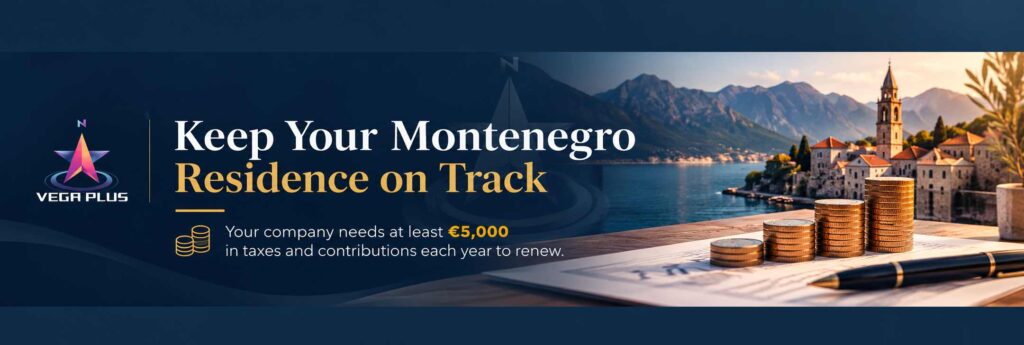
Parliament voted the amendments on the last day of 2025, and the key business provision is short. Registered entrepreneurs and directors who own more than 51% of their company can renew the permit only if the company paid at least €5,000 in taxes and contributions in the previous year. The first application is unaffected, and the test arrives twelve months later, when the authorities check your company’s payment record before approving another year.
The threshold does not apply to everyone. Whether it affects you depends on your citizenship, your ownership share and the basis of your residence. The table below shows who faces the test at renewal.
| Applicant profile | €5,000 test at renewal? |
| Non-EU national, director and owner of more than 51% | Yes |
| Citizen of an EU state, Iceland, Norway, Liechtenstein or Switzerland | No |
| Director who owns less than 51% of the company | No |
| Holder of permanent residence | No |
| Foreigner whose residence rests on another basis, such as family reunification | No |
What counts toward the €5,000?
The company’s taxes and social contributions together, which in practice means payroll taxes on the director’s salary plus corporate income tax, charged at 9%, 12% or 15% depending on profit.
A director on a modest monthly salary for the full year will usually come close to or past the line, but the exact figure depends on the salary level and on how much profit the company books.
The safest moment to run that calculation is January, well before the renewal date. Our accounting team at VegaPlus offers payroll calculation and employee registration, bookkeeping, monthly and annual reporting and ongoing compliance monitoring. Those are the records that show whether your company has paid enough in taxes and contributions by the time you file for renewal.
Two procedural rules sit beside the money test. Renewal applications must be filed at least 30 days before the current permit expires, and missed tax payments or deadlines can lead to a refusal. Applications for temporary residence and work permits can now also be submitted online.
One myth deserves a quick burial. You may still find articles claiming that foreign owners must hire two Montenegrin citizens. That proposal was withdrawn by the Government in December 2025 and never became law.
From Company Registration to Montenegro Residence Card
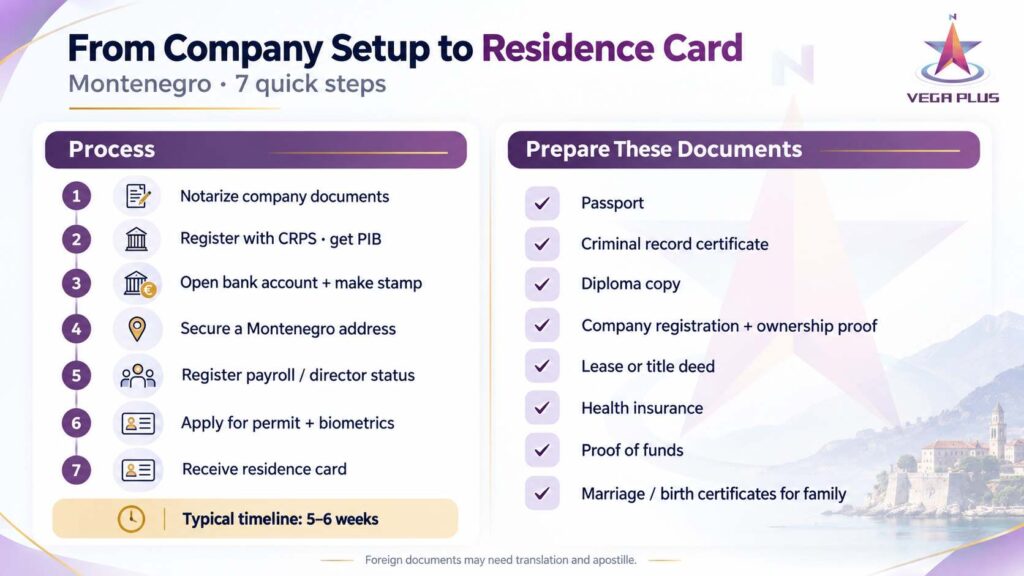
Company registration and the permit application follow a fixed order, because the permit relies on documents produced in the earlier steps. Most of the work is done before you ever meet an immigration officer. Our guide to company formation in Montenegro covers the registration stage in more detail.
- Founding documents. A notary certifies the founding act, the statute and the director’s signature. The Government’s business portal lists what the registry requires, and foreign founders add a certified, apostilled translation of the passport.
- Registration with the CRPS. File through the IRMS portal and pay the registration fee. The decision arrives within four business days, with the tax number (PIB) assigned automatically.
- Bank account and company stamp. The bank asks for the registration decision, the founding act and your passport.
- Address in Montenegro. A registered lease covers your accommodation and can also serve as the company seat.
- Payroll registration. Report yourself as director to the Tax Administration through the IOPPD return. Payroll and bookkeeping obligations start from the first month.
- Permit application. Apply at the Ministry of Interior office in your place of residence, or online. Biometric data is taken in person.
- Residence card. The whole process usually takes five to six weeks.
Documents for the Permit
The immigration office checks the same set of documents for every applicant. One expired certificate or a missing apostille can delay the whole application. Prepare the following before you file:
- Passport valid at least three months beyond the permit period
- Criminal record certificate, no older than six months, apostilled or double-certified where required
- Copy of your diploma (a secondary school certificate is enough)
- Company registration decision and proof of your ownership share
- Lease agreement or title deed for your accommodation
- Health insurance valid in Montenegro
- Proof of means of subsistence
- Marriage and birth certificates for family members
All foreign documents need a translation into Montenegrin by a court interpreter.
According to the Point of Single Contact, the application also carries an administrative tax and smaller charges for the permit form and the application itself. Most delays at this stage come from timing rather than eligibility, since a criminal record certificate can expire while it waits for an apostille.
Application preparation and submission is one of the residency services we offer at VegaPlus, together with work authorisation coordination and family reunification. If your spouse and children plan to join you, their requests can be prepared alongside your own application. That way the documents for the whole family follow the same timeline.
How Long Does the Montenegro Residency Permit Last?
One year, renewable every year for as long as the company meets the conditions. After five years of temporary residence, you can apply for permanent residence, and after another five years you become eligible for citizenship. The long-term path looks like this:
| Stage | Status | Renewal |
| Years 1 to 5 | Temporary residence and work permit | Yearly, filed at least 30 days before expiry |
| After 5 years | Permanent residence | Every 5 years, filed at least 60 days before expiry |
| After 10 years | Eligibility for citizenship | 5 years temporary + 5 years permanent |
A spouse and children under 18 can join through family reunification, and the amended law includes same-sex partners. Family members are not subject to the €5,000 test. Renewal and long-term support, including the move from temporary to permanent permits, is part of our residency service at VegaPlus.
Staying on the company route for five or ten years also raises tax questions, such as how much to take as salary and how much as dividends. Our tax advisory service covers corporate and personal tax planning, dividend and profit planning and tax optimisation strategies. Those decisions affect both your personal income and the €5,000 your company needs to show at each renewal.
Company Route or Property Route?
The company route suits people who want to work and earn in Montenegro. Property ownership suits those who only want to live there. The table compares the main options.
| Route | Core requirement | Right to work |
| Company (director and majority owner) | Registered DOO or entrepreneur; €5,000 a year in taxes and contributions from the first renewal (non-EU majority owners) | Yes, in your own company |
| Property ownership | Real estate with a tax value of at least €150,000 (non-EU nationals) | No |
| EU investor permit (proposed) | At least €250,000 invested in a Montenegrin business; permit for up to 3 + 3 years | Yes |
The EU investor permit is still before Parliament, and its status can be followed on the Parliament of Montenegro’s legislation page. Remote workers employed by foreign companies have a separate option in the digital nomad permit. Digital Nomad residence permits are also among the residency services we offer at VegaPlus, for clients whose income comes from abroad.
Frequently Asked Questions
At VegaPlus, we cover every stage of that path: business setup, accounting and payroll, tax advisory and residency permits, from your first application to renewals and permanent residence.
Whether you are still choosing between a DOO and an entrepreneur structure or already have a company and an upcoming renewal, the next step is the same. Contact our team, tell us where you are in the process, and we will assess your eligibility and the steps ahead.